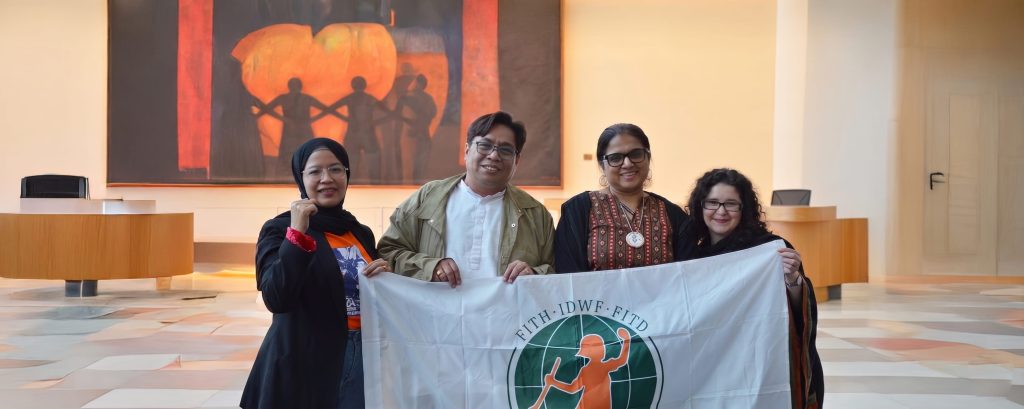
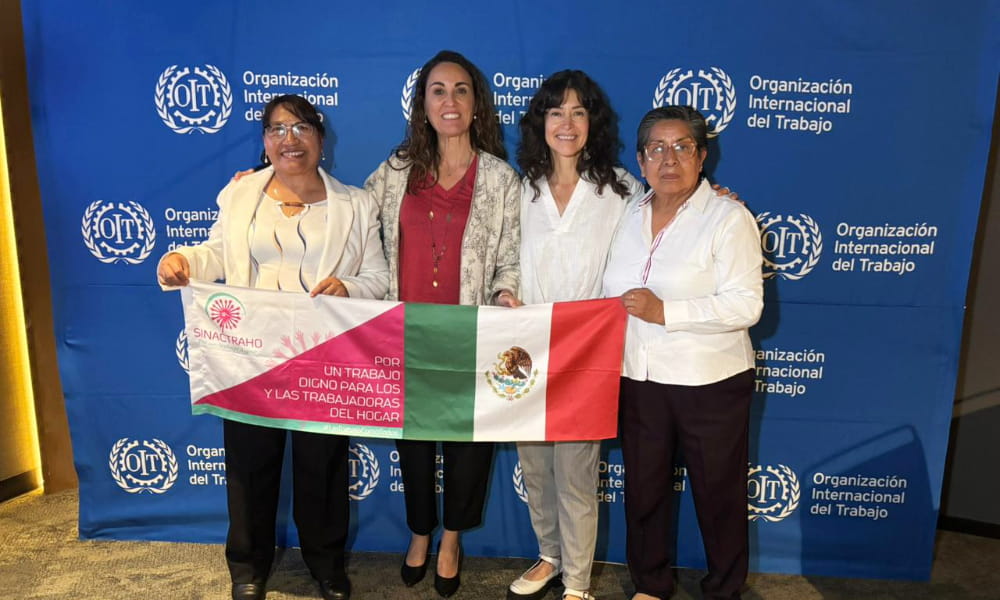
Adriana Paz Ramírez, General Secretary of the International Domestic Workers Federation (IDWF), together with leaders from SINACTRAHO Mexico, took part in the closing event of the ILO project “Promoting Social Justice and Gender Equality through Innovative Care Policies in Bolivia, Brazil, and Mexico.” Held on June 19 in Mexico City, the event also brought together ILO specialists from across Latin America and the Caribbean, Mexican government officials, and representatives of the employers’ sector.
The meeting presented the project’s key results, lessons learned, and recommendations, while also helping to strengthen tripartite social dialogue on the progress made, the challenges ahead, and the opportunities to consolidate labor policies on care. It also fostered recognition of paid domestic work as an essential part of care systems. Participants identified concrete actions and commitments to move forward with a regional care agenda that promotes more equal, inclusive, and sustainable societies.
One of the highlights of the event was the launch of the publication Domestic Work with Rights: A Guide for Workers and Employers, developed jointly by the ILO Office for Mexico and Cuba and the IDWF. Designed for both domestic workers and employers, the guide provides clear, practical, and accessible information on labor rights, obligations, and the minimum agreements needed to build dignified, fair, and respectful employment relationships in domestic work. It also offers guidance to help prevent conflicts, address frequently asked questions, and support compliance with national labor law and ILO Convention 189. As such, it is a key tool for promoting cultural change around domestic work and, in turn, tangible change in the lives of those who perform it.
Care provision is fundamental to people’s well-being, gender equality, economic development, and social cohesion. Yet care responsibilities continue to be distributed unequally, disproportionately affecting women and limiting their full participation in the labor market and in other areas of social life. At the same time, the nearly 15 million domestic workers who sustain the care economy in Latin America and the Caribbean — 91.1% of whom are women — continue to face major decent work deficits. Although the region has the highest number of ratifications of ILO Convention 189 and has made significant progress in national legislation, 71.3% of domestic workers in Latin America and the Caribbean are still in informal employment, limiting their effective access to labor rights, social protection, and care services for themselves and their families (ILO, 2021).
In a regional context marked by rising demand for care, a lack of recognition for those who provide it, and the unequal distribution of care responsibilities, the ILO project — launched in 2024 with the active participation of the IDWF and its affiliates in Bolivia, Brazil, and Mexico — has been instrumental in shaping a regional care agenda through social dialogue. After all, fair and equal care systems grounded in decent work can only be built with the voices of those who sustain them.
“This project is coming to a successful close, but the process and the path ahead do not end here. New doors are now opening to continue moving forward and deepening the strategic lines identified through tripartite social dialogue, with the aim of placing decent work for domestic workers at the center of national care plans and systems in these three countries. We must reduce the sector’s high decent work deficits. Formalization is essential, but it must go hand in hand with strategies to revalue domestic work.”
Adriana Paz Ramírez, IDWF General Secretary