In rural towns across Kenya, it is common to see hundreds of people gathered outside churches, schools, and community centers. Long lines also form outside convention halls in major cities and in the capital, Nairobi. They are jobseekers drawn by the job fairs and recruitment drives organized by the government as part of a nationwide campaign, launched in November 2024, to place one million Kenyans per year in jobs abroad over the next three years. Through this initiative, the government connects prospective migrant workers with recruiters and promises support to apply for passports and access loans to cover travel costs.
The push to migrate is not hard to understand. According to the latest official figures, in 2022 nearly 40 percent of Kenyans were living below the national poverty line — a figure that climbed to 43 percent in rural areas. At the same time, 17 percent of people under 34 were unemployed in a country where the economy is stagnant, the cost of living is soaring, and a rapidly growing population means that about 1 million Kenyans enter the workforce each year, but only a fifth find formal jobs. Against this backdrop, the government has been promoting the “export” of local labor, including to high-risk destinations, as a way to ease unemployment and support economic development.
In the face of a lack of opportunities and deep decent work deficits in Kenya’s domestic work sector (according to a 2026 ILO report, 94% of domestic workers in the country are in informal employment), more and more women are turning to jobs in the oil-rich Gulf countries, whose economies and societies increasingly rely on migrant domestic workers to meet their care needs. But labor migration does not play out on a level field for everyone involved. Destination countries benefit from cheap labor while continuing to avoid long-overdue structural labor reforms. Countries of origin benefit from remittances and ease local crises while failing to ensure proper protection for their nationals abroad. The recruitment industry makes millions while evading accountability. Caught in the middle are migrant domestic workers, who leave their homelands full of dreams and end up returning with broken hearts and empty pockets. If they return at all.
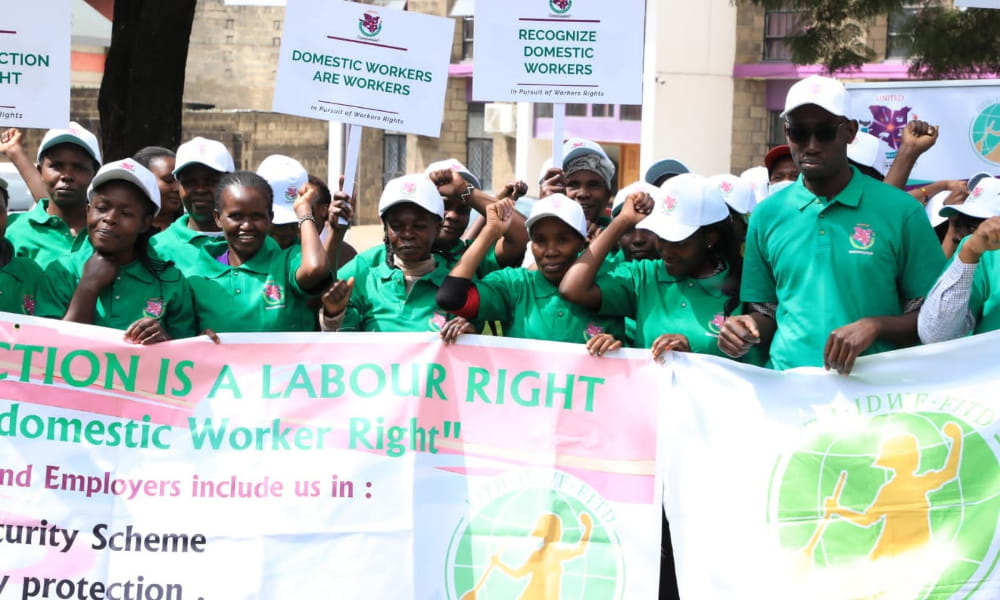
This reality has prompted the Kenya Union of Domestic, Hotels, Educational Institutions, Hospitals and Allied Workers (KUDHEIHA), with support from the International Domestic Workers Federation (IDWF), to step up its organizing, awareness-raising, and pre-departure training for prospective migrant domestic workers, with the aim of making labor migration safer. In the absence of government reintegration programs, the union also supports returnees through counseling and psychosocial services, legal advice, entrepreneurship training, seed funding for new businesses, and job placement assistance. In 2023, KUDHEIHA established the Migrant Domestic Workers Association, which has already organized and trained more than 1,000 migrant domestic workers nationwide and has actively advocated for meaningful reforms to Kenya’s labor migration policy.
This three-part story series follows Naomi Chemurgor and Mwanakombo Mwaita, two Kenyan migrant domestic workers who returned home after surviving exploitation and abuse in the Middle East, joined KUDHEIHA, and went on to become transformative leaders in Kenya’s domestic workers’ movement.