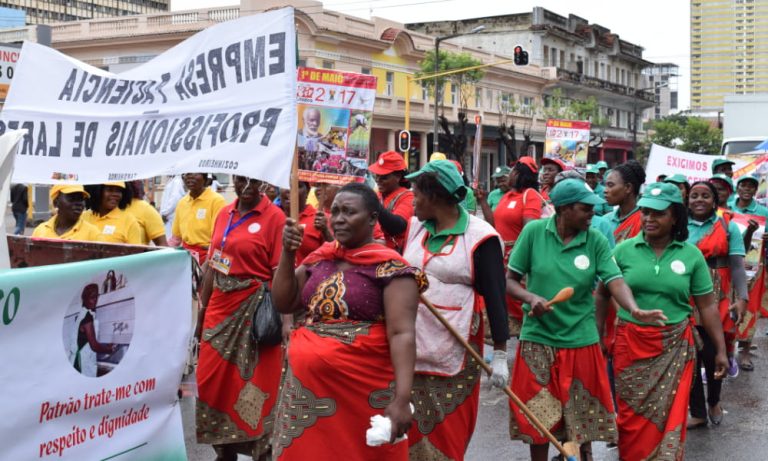
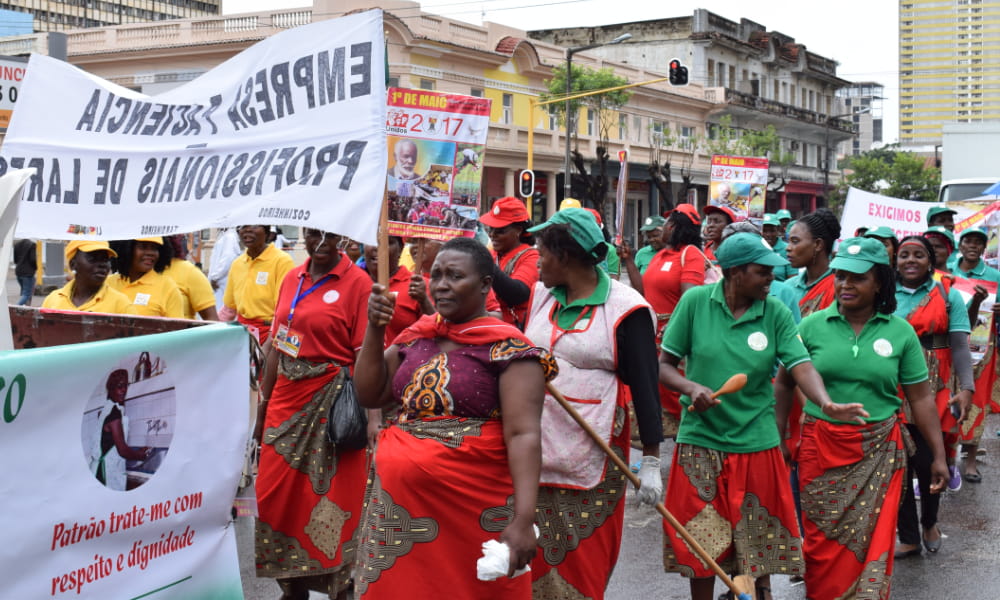
As a result of nearly two decades of mobilization and advocacy by the Sindicato Nacional dos Empregados Domésticos – SINED (National Union of Domestic Workers), Mozambique adopted Decree No. 52/2026, establishing a new Domestic Work Regulation and repealing Decree No. 40/2008, which had governed domestic work since 2008. The new Regulation, set to take effect on March 2, 2027, strengthens legal protections for domestic workers in line with Mozambique’s Labor Law and the principles of ILO Convention No. 189, not yet ratified by the country.
With the support and technical assistance of the trade union center Organização dos Trabalhadores de Moçambique (OTM-CS) and the Associação Moçambicana de Mulheres de Carreira Jurídica (Mozambican Association of Women in the Legal Profession), SINED was instrumental in the national consultation process led by the Ministry of Labor across all 10 provinces where the union is represented. “SINED played an important role not only in identifying workers’ concerns, but also in voicing and defending them throughout the discussion and review of the Regulation,” explains Cecília Mucambe, Acting General Secretary of SINED and a member of the Executive Committee of OTM-CS.
One of the key changes introduced by the new Regulation is mandatory social security coverage for domestic workers. Employers will be responsible for registering their workers with the INSS and paying the required monthly contributions. Under the previous regulatory framework, domestic workers could register with the INSS as self-employed workers and had to pay the contributions themselves.
The Regulation also requires written employment contracts specifying the employer’s and worker’s details, the place of work, the worker’s duties, remuneration, the duration of the employment relationship, and proof of social security registration. The absence of a written contract does not invalidate the employment relationship; instead, the omission is presumed to be the employer’s responsibility.
Another major provision is the introduction of a minimum wage for domestic workers. The government will set it following consultation with the Comissão Consultiva do Trabalho (CCT), a tripartite labor advisory body in which SINED is represented through its trade union center, OTM-CS. “A minimum wage is a tool for advancing decent work, valuing domestic work as a profession, and recognizing the contribution that thousands of domestic workers make to families and the economy. Domestic workers are predominantly women who, for many years, have worked in highly precarious conditions with little protection,” Mucambe says.
Working time is capped at eight hours per day and 48 hours per week, with one day of weekly rest and time off on national public holidays. Live-in domestic workers must have at least eight consecutive hours of rest at night. Domestic workers are also entitled to 12 days of paid annual leave during the first year of employment and 30 days from the second year onward, as well as 90 days of maternity leave and seven days of paternity leave. The probationary period is reduced from 90 to 60 days, while compensation for dismissal without just cause or termination by the worker for just cause increases from 10 to 30 days’ wages for each year of service.
The new legal framework also includes specific provisions to protect domestic workers from gender-based violence and harassment at work, explicitly defining conduct that may cause physical, psychological, sexual, or economic harm to them. When violence or harassment is perpetrated by the employer, an employer’s representative, or a supervisor, the worker is entitled to compensation equivalent to 20 months’ wages, in addition to any other legal remedies available. To combat child labor, the regulation sets the minimum age for domestic work at 18, while allowing workers as young as 15 in exceptional cases with authorization from their legal representative. It also provides protection against abusive disciplinary measures, strengthens occupational safety and health measures, and sets out the avenues available for resolving labor disputes.
In Mozambique, domestic work remains deeply undervalued and underrecognized, resulting in significant decent work deficits. Of the nearly half a million domestic workers in the country — who account for about 12% of wage employment — an estimated fewer than 1% are registered with the social security system. Domestic workers work an average of 54.4 hours per week, compared with 45.9 hours among other wage workers. On average, they earn less than one-third as much per month as other wage workers, and nearly two-thirds earn below the minimum wage (ILO, 2023).
While these figures leave little doubt about the urgent need to dignify domestic work and ensure decent working conditions for those who perform it, the new rules have sparked a heated online debate. Some argue that the new obligations are not financially viable for many households and could ultimately lead to higher levels of informality and job losses. Mucambe disagrees: “Having a minimum wage does not necessarily mean fewer job opportunities. Employers who cannot afford a full-time domestic worker can use more flexible arrangements, such as hiring someone only on certain days, while still respecting the rights and working conditions established by law.”
The controversy raises a broader debate about how care is currently organized and supported, and about the role of the state in reshaping it. Many families do face serious economic hardship, but these challenges cannot be addressed by shifting the costs onto one of the country’s least protected groups of workers. Care cannot be sustained at the expense of those who provide it. The state should promote a more equitable distribution of care responsibilities and guarantee universal social protection, quality public care services accessible to all, and decent work for those who care for Mozambican society.
For SINED, the struggle now enters a new phase: turning the new protections into reality. The union is already working to ensure effective enforcement of the new Regulation through large-scale awareness-raising and education campaigns targeting the general public, employers, domestic workers, and state institutions. It will also continue working with the government and allied organizations to monitor implementation, identify any challenges, and ensure that domestic workers’ rights are fully upheld.
“The new Regulation helps recognize domestic work as an occupation that must be carried out with dignity, rights, and social protection. Its adoption is an important achievement, but the real victory will be ensuring that the rights it establishes do not remain only on paper, but are widely known, effectively implemented and respected, and reflected in the daily lives of domestic workers across the country.”
Cecília Mucambe, SINED Acting General Secretary