On July 1, Brazil enacted Law No. 15,455/2026, establishing protection and support measures for domestic workers rescued from slavery-like conditions. This marks a major step forward in combating modern slavery in domestic work and safeguarding domestic workers’ rights.
Among its key provisions, the new law gives rescued workers priority access to Bolsa Família (Brazil’s federal cash transfer program) and increases the number of unemployment insurance payments they are entitled to from three to six. It also provides for support, labor market reintegration, and rehabilitation programs for survivors. To ensure immediate protection, the law establishes emergency measures and requires police authorities to report cases within 48 hours to the Ministry of Labor and Employment (MTE) and the Labor Prosecution Service (MPT).
For women, the law also allows, where applicable, the protective measures established under the Maria da Penha Law, including removing the perpetrator from the home, prohibiting them from approaching or contacting the survivor, electronic monitoring, and referral to protection programs. It also increases penalties for certain offenses committed against domestic workers and strengthens labor inspection mechanisms in domestic work. To that end, it introduces specific amendments to the Penal Code, the Maria da Penha Law, and Complementary Law No. 150/2015, which regulates domestic work.
For Valdirene Boaventura, Secretary for Legal Affairs of the Federação Nacional das Trabalhadoras Domésticas – FENATRAD (National Federation of Domestic Workers), and herself a survivor of slave labor, “the new legislation recognizes the need for specific protections for victims of slave labor, most of whom are Black women, ensuring they receive support, multidisciplinary care, and the conditions they need to rebuild their lives.”
“This law is historic because, for the first time, public authorities and employers are required to protect and support domestic workers who are victims of slave labor. It puts an end to simply rescuing workers and leaving it at that. This is a form of historical reparation.”
Valdirene Boaventura, FENATRAD leader
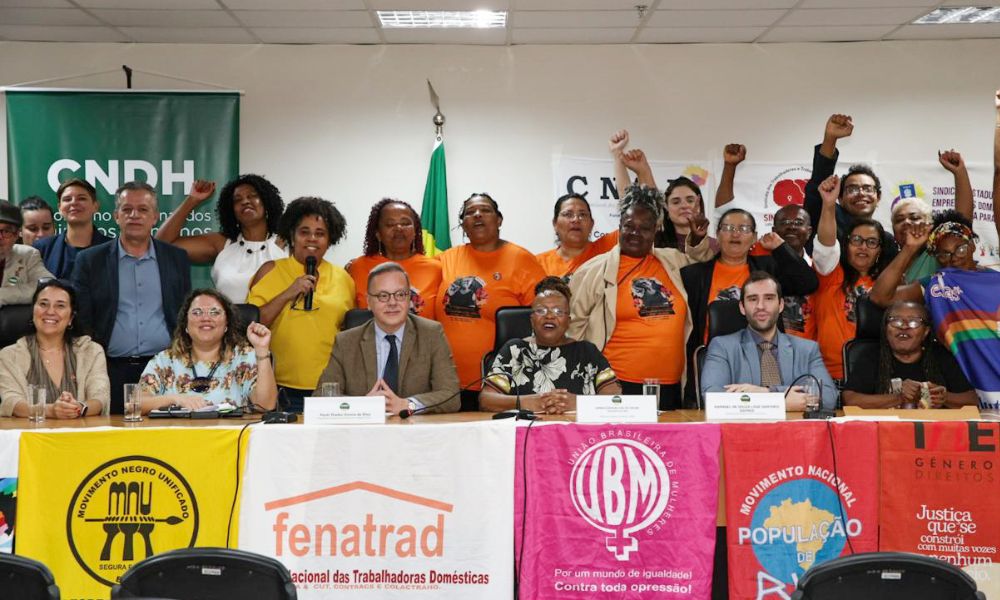
On August 6, in another measure aimed at advancing the implementation of international standards and strengthening enforcement of national law, the National Human Rights Council (CNDH) approved a resolution setting out parameters to expand protections for domestic workers’ rights. Drafted by Themis – Gênero, Justiça e Direitos Humanos and FENATRAD, the document sets out recommendations for public authorities and institutions responsible for upholding labor and human rights, aimed at promoting formalization, access to social protection, stronger trade union organizing, access to justice, and decent work.
These initiatives come in response to FENATRAD’s sustained mobilization against the inequalities and injustices domestic workers have historically endured in Brazil. FENATRAD’s long-standing alliances with Black, feminist, and other social movements have also been instrumental in securing these and other gains, including Brazil’s ratification of ILO Convention No. 189, Constitutional Amendment No. 72 of 2013, known as the “PEC das Domésticas,” and its 2015 implementing legislation, Complementary Law No. 150.
Although domestic work now has legal recognition in Brazil, that recognition has yet to translate fully into practice. The daily lives of the country’s 5.6 million domestic workers — 92% of whom are women, 68% of them Black — are still shaped by a culture rooted in Brazil’s history of slavery and colonialism, reflected in widespread employer noncompliance with labor laws and in the discrimination, exploitation, and other forms of abuse these workers continue to face. The gap is stark: about 76% of domestic workers are informally employed, while 65% have no social security coverage (MTE, 2026).
Between 2017 — the year Brazil began formally addressing contemporary forms of slavery in domestic work — and 2025, 172 domestic workers were rescued from slavery-like conditions (MTE, 2025). According to research by the Federal University of Minas Gerais, rescued domestic workers had spent an average of 26 years in those conditions; 45% had been recruited while still minors, and about 75% were illiterate Black women. More than half were over the age of 50 when they were rescued.
In Brazil, girls from vulnerable communities are still frequently recruited by wealthy families with promises of a well-paid job and the opportunity to go to school. Their parents, living in extreme poverty, accept these offers without realizing what awaits their daughters. Most of these girls, under the guise of being “like family,” end up subjected to grueling hours of unpaid domestic and care work. Over time, they become confined to the homes where they live and work — often in precarious conditions — cut off from the outside world and from their own families, leaving them exposed to human rights violations, including gender-based violence and sexual abuse.
After spending their entire lives dependent on those exploiting them, enslaved domestic workers often reach old age with no education, no savings, no place to live, no access to a pension or social protection, no government support and, in many cases, no family to take them in. When they are rescued — if they are rescued at all — they are often just as alone and unprotected as they were while enslaved. Many have so deeply normalized their situation that they do not even recognize it as slavery and may even see themselves as part of the very families that stole their lives. Yet while several people have been criminally convicted for subjecting domestic workers to slave labor, and many have been ordered to compensate survivors, no one has yet gone to prison for this crime.
One of the greatest challenges in ending slavery in domestic work is the difficulty of inspecting private homes. If the employer does not consent to an inspection, authorities must respect the constitutional protection of the inviolability of the home. Inspections without consent may only be carried out with a court order, generally issued when there is a substantiated complaint of labor exploitation in a household. Even then, violations are often obscured by the long-standing “family-like” relationship between household members and the enslaved domestic worker.
Eighty years passed between the founding of Brazil’s first domestic workers’ association and the recognition of domestic work as work and its regulation by law in 2015. Today, after nearly a century of sustained struggle, the domestic workers’ movement has won another crucial legal protection. It is time for those hard-won gains to move from paper into practice. Decent work and dignity for domestic workers cannot wait another hundred years.