Migration without Rights is Exploitation
A Call from Migrant Domestic Workers to the International Migration Review Forum 2026
As governments, trade unions, and civil society organizations gather at the International Migration Review From (IMRF) in New York City this year, migrant domestic workers from around the world come together with a clear and urgent message:
Migration without rights is exploitation.
There are over 75 million domestic workers worldwide, including more than 12 million migrant workers1, the majority of whom are women. Domestic workers migrate to sustain families, communities, and economies –caring for children, supporting older persons, and making all other work possible.
Yet as the global demand for care continues to rise (ILO, 2025.), the rights of those who provide care remain systematically denied.
In South East Asia alone, nearly 30% of migrant domestic workers are in conditions of forced labour (ILO, 2023), including underpayment, excessive working hours, violence and abuse, and restrictions on freedom of movement.
In migration systems across the world, domestic work remains undervalued and excluded from labour protections. Migrant domestic workers – especially those in irregular situations – face barriers related to legal status, employer dependency, and limited access to protection and justice. Many often experience unsafe working conditions, forced labour, and risks of detention and deportation when seeking help. This is not a gap. It is a structural failure of migration governance that continues to prioritize labour supply over human dignity and decent work.
At a time when investments in care systems are increasing, we must confront a critical reality: without rights for migrant workers, there can be no just migration system – and no just care system.
A system built on inequality
Migrant domestic workers migrate in contexts shaped by inequality, climate change, conflict, war and poverty. These conditions leave many with little choice but to migrate –and once across borders, , their rights are often taken away.
Many migrant domestic workers face:
- long working hours without rest
- no weekly day-off
- violence and harassment, including physical, emotional, and sexual abuse
- non-payment of wages and salary deductions
- restrictions on movement and the right to change employers
- recruitment fees and debt bondage
- confiscation of identity documents and dependency on employers for legal status
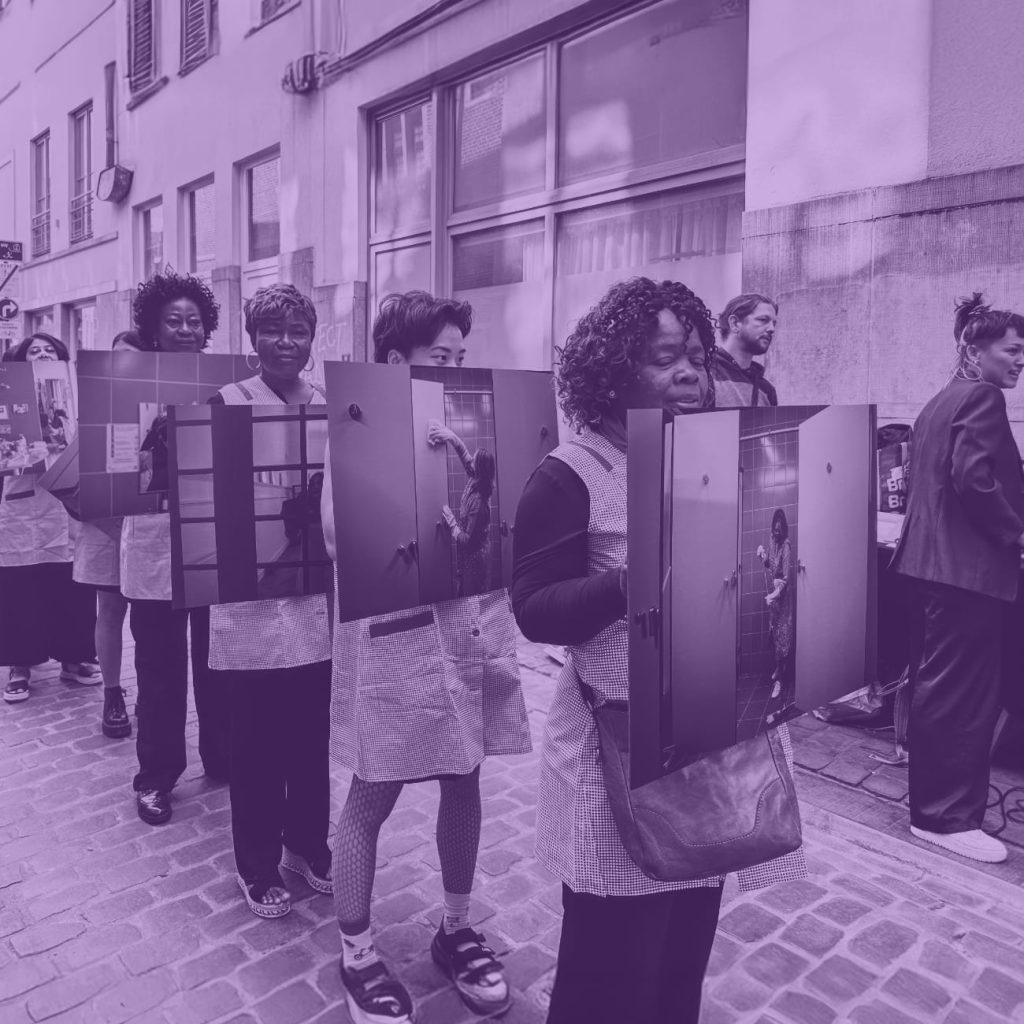
- isolation in private households
- lack of access to justice
Temporary migration systems often place migrant domestic workers in situations of heightened vulnerability and exploitation.
In systems such as kafala and other employer-tied visa regimes, women migrant workers – and in some cases children – are placed under near-total control of employers, significantly increasing the risk of abuse and exploitation.
Workers are often unable to leave abusive situations or change employers without risking detention or deportation. These conditions are widely recognized as forms of modern-day slavery.
Even where legal protection exists in some countries, enforcement is weak. Domestic work is often excluded from labour inspections systems, leaving employers with little accountability. High levels of informality, combined with fear of retaliation, detention, or deportation, prevent many migrant workers from claiming their rights.
Migrant domestic workers organizing and leading change
Migrant domestic workers’ rights to organize and freedom to association are frequently denied, limiting their ability to participate in labour and policy dialogue. In many destination countries, legal and administrative barriers restrict the formation and registration of trade unions, preventing workers from collectively advocating for their rights.
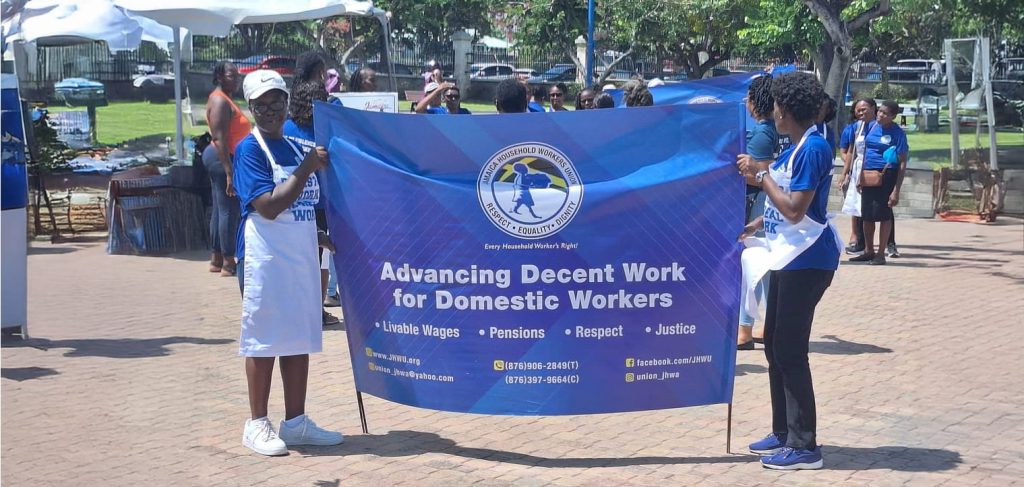
Despite these barriers, migrant domestic workers are organizing across regions, building unions and transforming policies.
Through the International Domestic Workers Federation (IDWF) and its affiliates, workers have:
- advanced ratification and implementation of ILO Conventions 189 on Domestic Workers and 190 on Gender Based Violence and Harassment in the World of Work)
- secured labour law reforms and expanded access to social protection
- contributed to the adoption of Domestic Workers’ Law in across the world, strengthening recognition and protection
- extended access to benefits such as healthcare, work-place injury benefits, and pensions schemes.
- challenge abusive migration and recruitment systems by bringing workers’ voices into policy spaces
- built transnational solidarity and leadership – especially in times of crisis, including in the Middle East
In regions such as the Middle East and North Africa, ongoing crises expose the failure of migration systems to protect workers. Many lack access to evacuation routes, protection, or basic rights.
“My house was bombed… my husband was killed by a strike at the beginning of the war… my employers’ houses were either bombed or they fled…and now I have no house and no job.”
— Rahel (Ethiopian, Lebanon)
In Asia-Pacific, migrant domestic workers have actively engaged in IMRF review processes, contributing to regional discussions and bringing forward priorities rooted in workers’reality. Together with IDWF workers’ leaders from other regions, they are bringing their experiences into IMRF discussions to strengthen accountability.
From commitments to action
At IMRF 2026, IDWF call on governments to move beyond commitments and take concrete action:
- Recognize domestic workers as workers with rights: Ratify and implement ILO Convention No. 189, ensuring that migrant domestic workers are protected under labour laws regardless of their nationality, sector, or migration status.
- Guarantee freedom of association and collective bargaining: Ratify ILO convention 87 and 98 and remove legal barriers preventing migrant domestic workers’ from organizing. Protect workers from retaliation and deportation when exercising these rights.
- Transform migration systems: Replace temporary and employer-tied visa systems with rights-based migration pathways that allow workers to change employers, access justice, and live with dignity. Abolish kafala systems and ensure access to permanent residency pathways.
- Build just care systems: Anchor national care systems in ILO Convention 189 and ensure migrant domestic workers are fully included in care policies.
- Guarantee inclusive and portable social protection: Ensure access to healthcare, workplace injury protection, maternity benefits, unemployment support and pensions. Guarantee portability of benefits across borders.
- End exploitation in recruitment: Enforce zero-fee recruitment and the employer-pay principle. Strengthen regulation and accountability of recruitment agencies.
- Protect workers in crisis and conflict: Establish evacuation mechanisms, humanitarian protection, and access to shelter, services and reintegration support – with non-discrimination. DWF Statement: Migrant Domestic Workers and the Escalating War in the Middle East
Read:
- Labour’s Position on the 2026 International Migration Review Forum Progress Declaration
- WIMN Feminist Manifesto
A call for a different future
The care economy will continue to grow. Migrant domestic workers are already at its center.
As we mark International Workers’ Day on May 1 and look ahead to the International Labour Conference, this moment calls for renewed commitment to labour rights, gender justice, and dignity for all workers.
IDWF Calendar of Engagements
IMRF 2026
Safe, orderly and regular migration along Asia-Pacific and Arab Region Migration Corridor
30 April | 15:00 – 16:30 EST
Virtual: https://zoom.us/webinar/register/WN_Q-Npbyf9QWCTN–VBnkZ_Q#/registration
Convened by: Government of Nepal, ESCAP, ESCWA, ILO, IOM, UN Women, UN Network on Migration
Description: Regional dialogue connecting Asia-Pacific and Arab States to advance rights-based migration governance, with a focus on labour mobility corridors and protection of migrant workers.
Migrant Forum in Asia (MFA) – Civil Society Day
03 May | 9:00 – 17:00 EST
Location: Holiday Inn Express, in person
Convened by: Migrant Forum in Asia Description: Pre-IMRF civil society convening to align advocacy priorities, strengthen solidarity, and coordinate collective strategies to influence IMRF outcomes.
‘Uniting for the IMRF’ Action Committee Civil Society Day for the 2nd IMRF
03 May | 9:00 – 15:30 EST
Location: Hybrid and in New York, Church Centre of the UN
Interpretation: English, French and Spanish
IMRF Multi Stakeholder Hearing
04 May | 10:00 – 16:00 EST
Location: UN Secretariat, New York (in person)
Convened by: United Nations General Assembly / UN Network on Migration
Description: Official multi-stakeholder platform bringing together governments, UN agencies, trade unions, and civil society to shape the IMRF agenda and highlight key priorities on human rights and migration governance.
Empowerment and Rights Protection of Women Migrant Workers in the Care Economy
07 May | 8:30 – 9:30 EST
Location: ILO Office, New York (hybrid)
Registration in-person: Side-event: Empowerment & Rights Protection of Women Migrant Workers in the Care Economy – Fill in form.
Registration virtual: https://events.teams.microsoft.com/event/d6e032bc-84b4-47cc-82a1-251daaf37912@d49b07ca-2302-4e7c-b2cb-e12127852850
Convened by: Government partners, UN agencies, trade union and civil society
Description: High-level dialogue on access to services and justice, and the role of organizing and collective bargaining in advancing rights for migrant domestic workers in the care economy.
WIMN: Women Caucus at The IMRF 2026 07 May | 12:00 – 15:00 EST
Location: Church Center for the UN (CCUN), New York (in person)
Convened by: Women in Migration Network (WIMN) and partners
Description: Official launch of the Spotlight Report, presenting a rights-based, migrant-centered, and gender-responsive analysis to inform IMRF discussions and policy commitments.
MFA Side Event – Care Economy: Rights, Recognition, and Redistribution
07 May | 15:15 – 17:00 EST
Location: Ford Foundation Headquarters, New York (hybrid)
Convened by: Migrant Forum in Asia (MFA) and partners
Description: Strategic discussion on migrant-led care economies, addressing structural inequalities, labour rights, and the need for recognition and redistribution in global care systems.
Towards Migration Governance with a Care Perspective
08 May | 13:00 – 15:00 EST
Location: Church Center for the UN (CCUN), New York (in person & virtual)
Registration (Eng, Esp): https://forms.gle/G4cYquXDBWSNTUoY9
Convened by: Bloque LAC, Dejusticia, IMUMI, IDWF, ITUC, UN Women, WIMN, Global Alliance for Care, and partners
Description: Multi-stakeholder dialogue advancing policy coherence between migration and care systems, with a focus on rights-based approaches, gender equality, and transnational care dynamics.
1 A Paz, Bariya, G Papa, Migrant Domestic Workers in the Care Economy: Essential but Unprotected; Spotlight Report on Global Migration 2026, P. 14-17, 2026, WIMN, FES.