By Barbara Sibbald
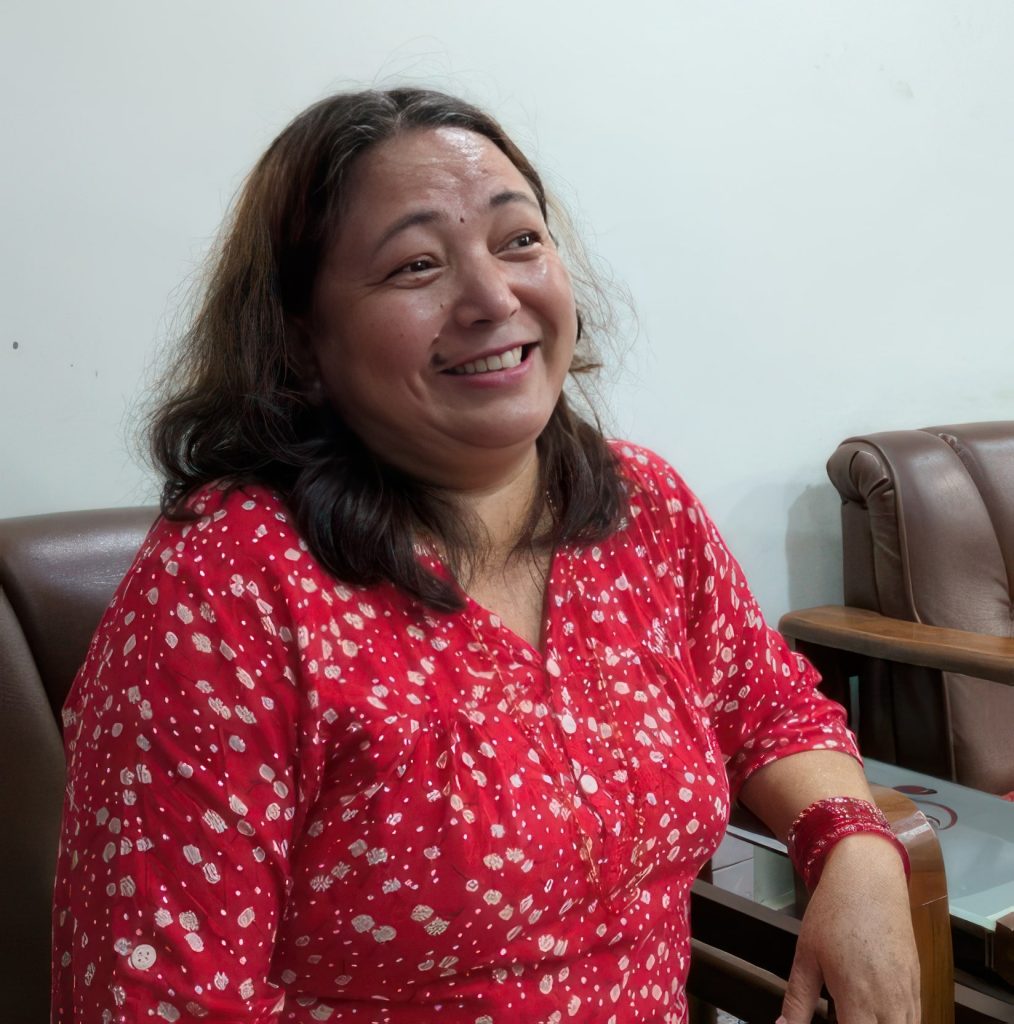
Sabriti Chaudhary had been a domestic worker in Kathmandu, Nepal for 17 years, when one of her five employers unjustly accused her of stealing 35,000 Nepalese rupees ($248 US).
As she desperately searched for someone to help her, she “heard the name, Gyanu Kshatri.”
Gyanu is the General Secretary of the Homeworkers’ Trade Union of Nepal (HUN), which was established in 2006 to fight for legal recognition and the rights of domestic workers. It now has 5,310 members.
Gyanu believed in Sabriti’s innocence and set up a “collective bargaining” meeting with her employer.
“He came to agree that she was not a thief,” said Gyanu. With Sabriti’s innocence established, she also got seven-months back pay the employer had been withholding.
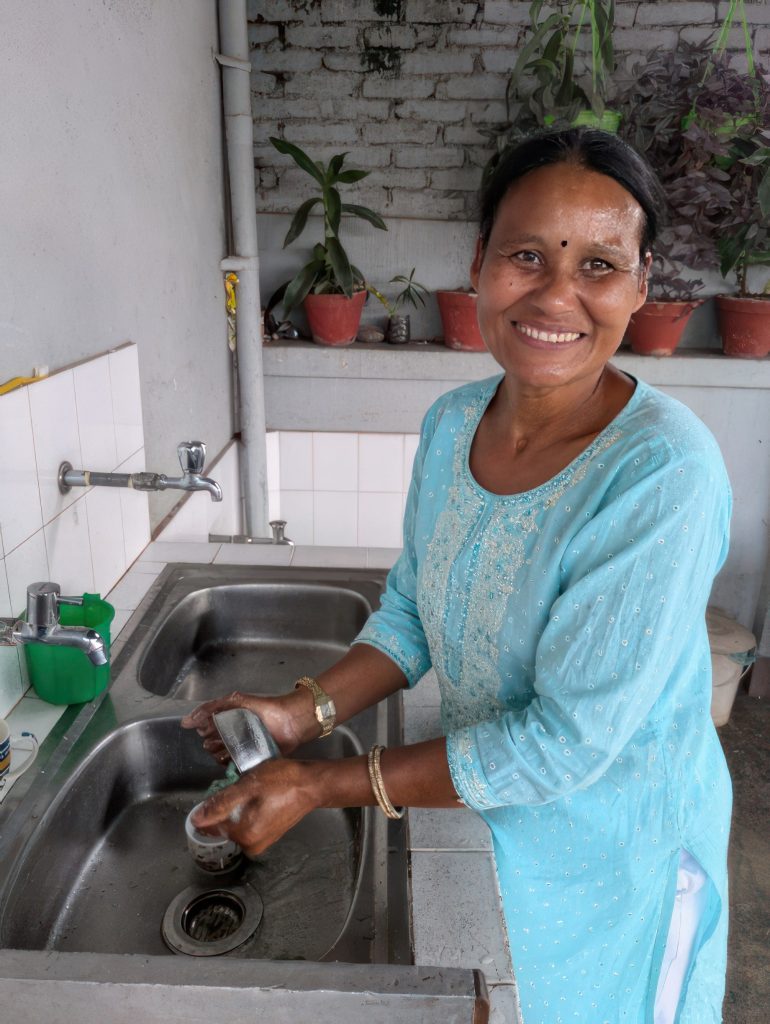
Sabriti joined HUN that year: 2022. “Now, I’m not afraid,” she said, her gesturing hands emphasizing her words. “I’m very confident. Everyone here will back me up. It’s very inspiring. Before I did not know about this union, now I feel a sense of belonging.” So much so, that Sabriti convinces other domestic workers to join and has so far recruited 30 people. She arrives at the HUN office bearing a radiant smile and a handful of new registration forms. Nepal has an estimated 200,000 domestic workers, so recruitment is a big priority.
HUN is not working alone. It is affiliated with the General Federation of Nepalese Trade Unions (GEFONT), which assists 23 organizations of informal workers, and the International Domestic Workers Federation (IDWF), an advocate for rights of domestic workers working in 69 countries with 669,000 members.
With support from these organizations, HUN offers members courses. Nearly 700 domestic workers have taken its intensive 5-day training program that teaches advocacy, skills development, financial literacy, self-defence and more.
Sabriti took two-days of training in leadership development, advocating for social security (including state pensions), and more. In one course, she learned how to use personal protective equipment to safely make a liquid cleaning product, which she now bottles and successfully sells door-to-door.
She also continues to be a live-out domestic worker at four houses and a school because she loves the flexibility of it, but when she began, she had no choice. Her husband, a “severe alcoholic,” worked until he went blind in 2004. Sabriti had to work for the sake of the family, which includes three daughters, now aged 28, 26 and 22, but she had never worked outside the home before. She began as a caretaker at a school then added people’s homes. Her husband died in 2024. Her middle daughter now lives in Dubai while the two others live with her. One cooks snacks in an office; the other holds a bachelor’s degree in journalism and works in media.
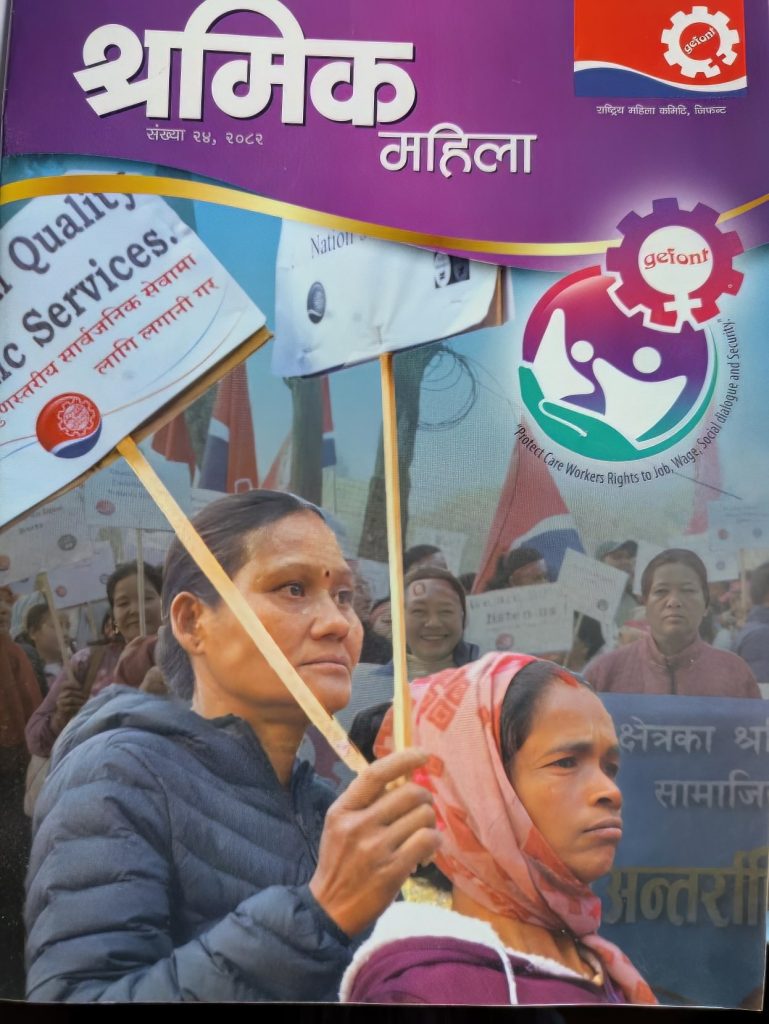
Sabriti has become increasingly active in HUN through the years. Recently she demonstrated for workers’ rights and was featured on the cover of GEFONT’s journal. She also attended an IDWF-sponsored meeting in June and was thrilled to have her photo taken with a minister of labour.
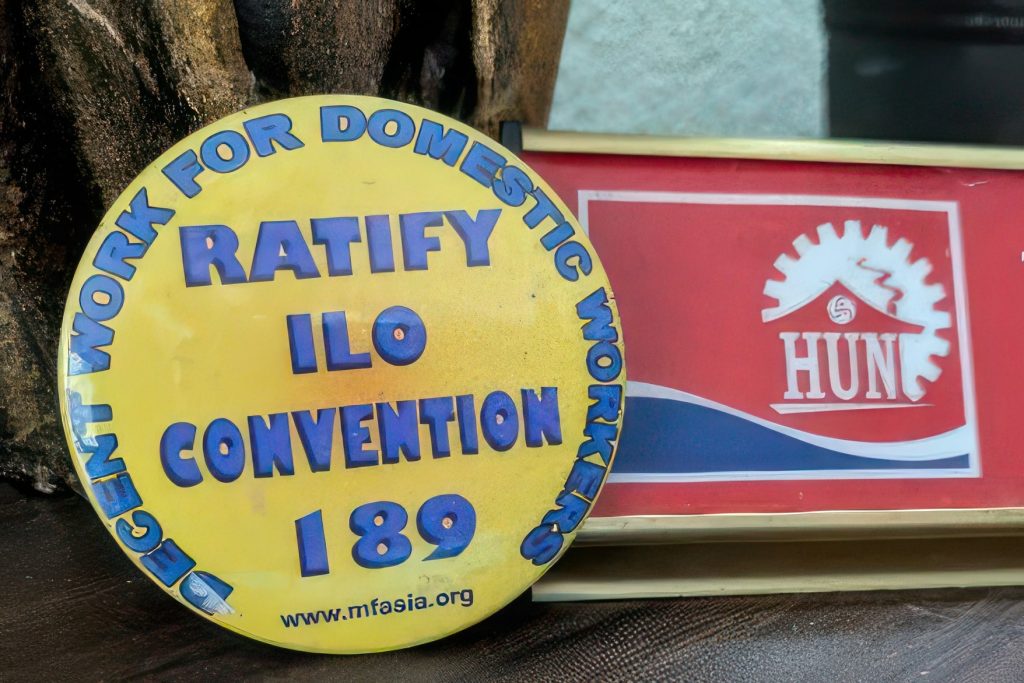
That meeting was part of HUN’s tireless efforts to convince the government to ratify the International Labour Organizations’ Domestic Workers Convention 189, which would establish workers’ rights to unionize and collective bargaining, to decent and safe working conditions, formal contracts with employers, social security (such as Nepal’s shared-contribution pensions), a minimum wage and more. HUN circulated a petition advocating for Convention 189, which was signed by about 3,500 people, and they repeatedly advocate to municipalities across Nepal.
In addition, the IDWF applies pressure globally.
Some HUN members have now entered politics: a former president is one province’s industry ministry, and a domestic worker is on Kathmandu council, while another holds office in Pokhara Province. “These are milestones,” said Gyanu.
All this work may soon have very positive results: HUN has been told that Convention189 will be ratified in Nepal in 2026.
Gyanu said she is thrilled at the prospect. “Domestic Workers are essential workers,” she said. They provide child and elder care, as well as doing household tasks. “Without them people couldn’t earn money.” About 99% of Nepal’s domestic workers are women.
The progress toward ratifying Convention 189 has also helped change attitudes, said Gyanu. “Before politicians would ask why I was coming to them, why should workers get a minimum wage. Now they have changed. There is less discrimination, although it’s not eliminated. It takes time to change attitudes.”
Sabriti pointed out examples of this discrimination: workers who are offered tea in a broken cup, or given food “like it was for an animal”, or told they can’t sit on the sofa, they must sit on the floor. “Why are we treated so inhumanely?” she asks. “I understand that they might be educated well and doing a better paid job. We respect their work but that doesn’t mean they have the right to treat up in a negative way. We should be recognized, respected and treated equally because we are all human beings.”
To achieve this, “domestic workers need to be organized and united so we fight for our rights. Everyone should join,” says Sabriti. “This is my hope.”
As the interview winds down, Sabriti finds a cloth to wipe tea-cup rings off the desk, then wipes it all down. She obviously takes pride, but also pleasure, in her work.