Terms of Reference: Local Research Consultant (Morocco)
Regional Research Project: Models of Domestic Worker Organizing in the MENA Region
International Domestic Workers Federation (IDWF)
Background
IDWF is conducting a regional research project documenting existing and past models of domestic worker organizing across several countries in the MENA region. The research will examine both formal and informal organizing efforts, with the aim of producing a curriculum that can be used by domestic worker groups, organizers, and supporting NGOs across the region.
The project recognizes that domestic workers in the region — particularly those operating under the kafala system — face severe structural barriers to organizing, and that existing organizing efforts are largely undocumented and rarely shared across borders. The curriculum will offer concrete, contextually grounded examples of how workers have organized under difficult conditions, providing practical models and strategies.
IDWF is recruiting one local consultant per country for each of the five countries included in this research: Lebanon, Jordan, Morocco, Qatar, and Bahrain.
Purpose of This Consultancy
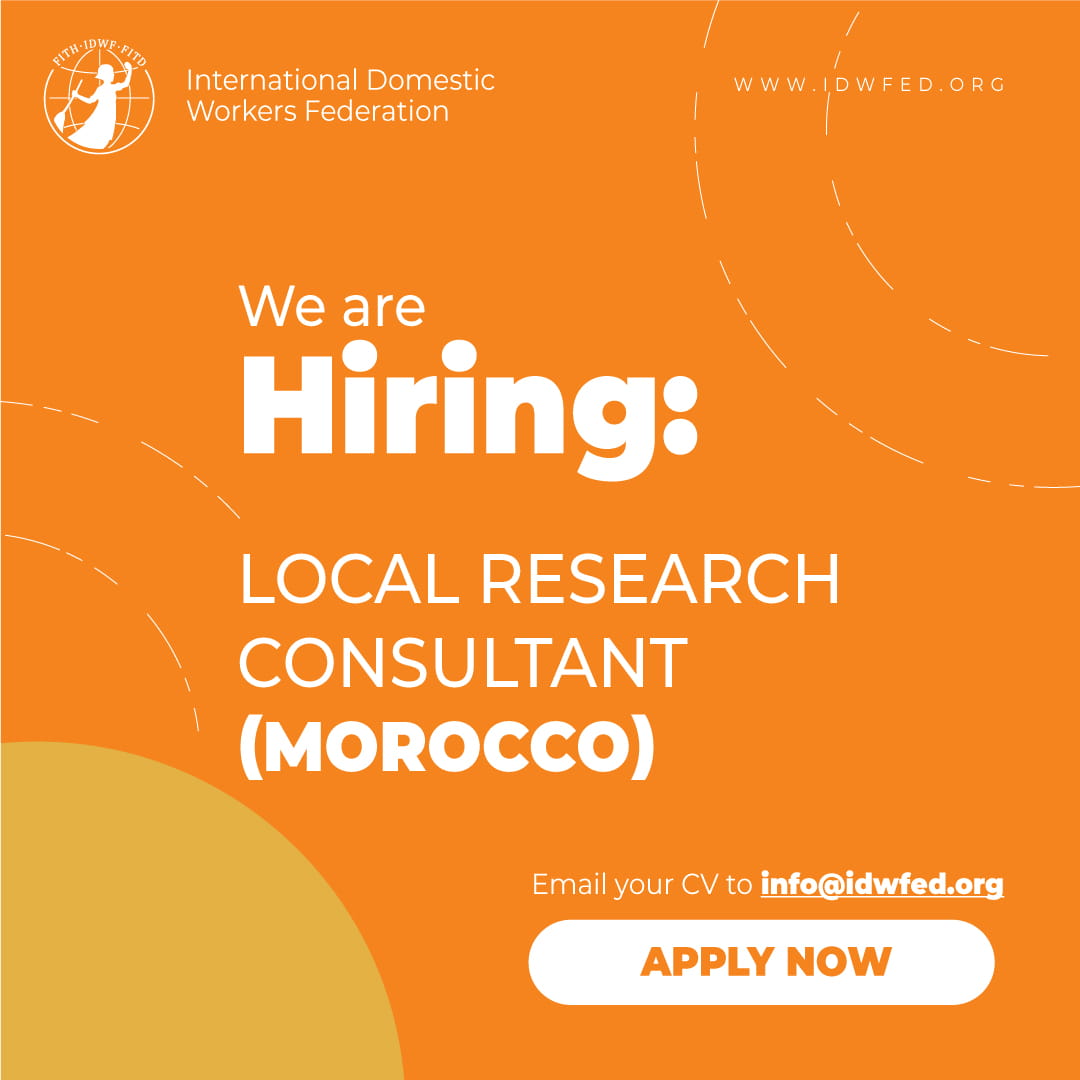
IDWF is seeking a local consultant in Morocco to lead the in-country research to identify practical organizing lessons and approaches from Morocco that can inform peer learning across the region. The consultant will be responsible for mapping domestic worker organizing efforts in their country, conducting and facilitating interviews and focus group discussions, transcribing them, and producing a country report that will feed into the regional synthesis and training curriculum. The consultant will work closely with IDWF’s regional coordinator throughout the research period.
Scope of Work
The consultant will be responsible for the following:
- Mapping: Identify and document existing and past domestic worker organizing efforts in the country, both formal and informal (organizations, mutual aid networks, community groups, peer support structures, etc.). The mapping should capture who these groups are, how they are structured, and what they do — without collecting or publishing identifying information.
- Interviews and Focus Group Discussions: Identify and conduct in-depth interviews and/or focus group discussions with domestic workers, organizers, and relevant stakeholders. Interviews and focus group discussions should gather rich, detailed accounts of organizing in practice — the strategies used, challenges faced, and how workers navigated or overcame those challenges.
- Transcription: Transcribe all interviews and focus group discussions in full. Transcripts should be accurate and clearly organized.
- Country Report: Produce a country report of 15–25 pages compiling the findings and excluding annexes. The report should include:
- Contextual information relevant to understanding the organizing environment
- An overview of the domestic worker organizing landscape in the country
- A summary of mapped groups and networks
- Key findings from interviews and focus group discussions, organized thematically
- Three case studies of particularly useful organizing experiences that exist in the country
- Documentation of challenges and how they were navigated
The report is an internal working document. It does not need to be a polished publication — clarity, accuracy, and richness of detail are the priority. The report will be used as source material for a regional synthesis and training curriculum produced by IDWF.
The IDWF will be responsible for:
- Providing information, background and context about the groups of MDWs that IDWF has engagement with
- Providing a draft research methodology and guiding framework, and working collaboratively with the consultant to adapt it to the country context prior to the start of fieldwork
- Providing an introduction or referral to relevant contacts and networks where possible, to facilitate access to communities and interviewees
- Reviewing and providing timely feedback on the first draft of the country report to enable the consultant to submit a final version within the agreed timeline
Qualifications
The ideal candidate will have:
- An advanced university degree (PhD, MA preferred) in migration, labour studies, sociology, gender studies, law, international development or a related field with demonstrated research experience
- Demonstrable experience conducting qualitative research, including in-depth interviews and focus group discussions
- Existing relationships or networks within domestic worker communities, labor rights organizations, or migrant worker advocacy spaces in the country
- Strong understanding of the local labor rights and/or migration context
- Experience working on sensitive research topics with vulnerable or at-risk populations, including applying ethical research protocols
- Excellent written communication skills, with the ability to produce clear, well-organized reports
- Fluency in Arabic and English (written and spoken); knowledge of additional relevant languages — such as Tagalog, Sinhala, Amharic, French, or other languages spoken by domestic worker communities in the country — is an asset
- Ability to work independently and manage their own timeline within the project schedule
- The applicant is expected to be based in, or already familiar with, the country where the consultancy will take place. IDWF does not provide accommodation support or cover any travel or flight costs for this role
Timeline
The consultancy will run from September 1st, 2026 to November 30th, 2026. The consultancy is expected to require approximately 20–28 working days over the course of the assignment. The exact number of working days will be confirmed with each consultant once the research methodology has been adapted to the country context, taking into account the scope of mapping and the anticipated number of interviews and focus group discussions.
Payment
Fees will be paid in two instalments:
- 50% on signing of the consultancy agreement
- 50% on submission of the final country report, following review and acceptance by IDWF
Reporting and Coordination
The consultant will work in close coordination with IDWF’s regional coordinator, Nada Wahba, who will be the primary point of contact throughout the consultancy. Regular check-ins will be scheduled to track progress, address any challenges, and ensure alignment with the broader project.
Intellectual Property, Data Ownership and Confidentiality
All deliverables produced under this consultancy, including but not limited to interview and focus group discussion transcripts, filed notes, recordings, reports, databases, directories, photos, and any other materials developed as part of this consultancy, shall become the property of the IDWF.
The consultant therefore agrees to transfer all intellectual property rights related to the commissioned work upon completion of the consultancy. The consultant may not publish, distribute, reproduce, or otherwise use the research findings without the prior written authorization of IDWF.
All data collected must be handled in accordance with the ethical and security obligations outlined in these Terms of Reference. IDWF reserves the right to use, adapt, translate, reproduce, publish and incorporate the research findings, while respecting confidentiality commitments made.
Ethical and Security Obligations
The consultant is expected to uphold strict ethical standards throughout. This includes:
- Obtaining informed consent from all interview and focus group discussion participants
- Anonymizing all data from the point of collection
- Storing data securely and not sharing it with third parties
- Being transparent with participants about the purpose of the research and how their information will be used
The consultant shall not disclose the identity or location of any participant or organization where doing so could place individuals at risk. Particular care should be taken when documenting organizing efforts that may have involved migrant workers, or workers operating in restrictive environments.
How to Apply
Interested candidates should submit the following to info@idwfed.org by 23 August 2026:
- A brief expression of interest (no more than one page) describing their relevant experience and why they are well placed to conduct this research
- A CV or resume
- One writing sample that best demonstrates the applicant’s research or analytical writing ability (research reports, published articles, academic papers, or other substantive written work)
- An indication of daily consultancy rate in USD
For questions or further information, please contact us at info@idwfed.org